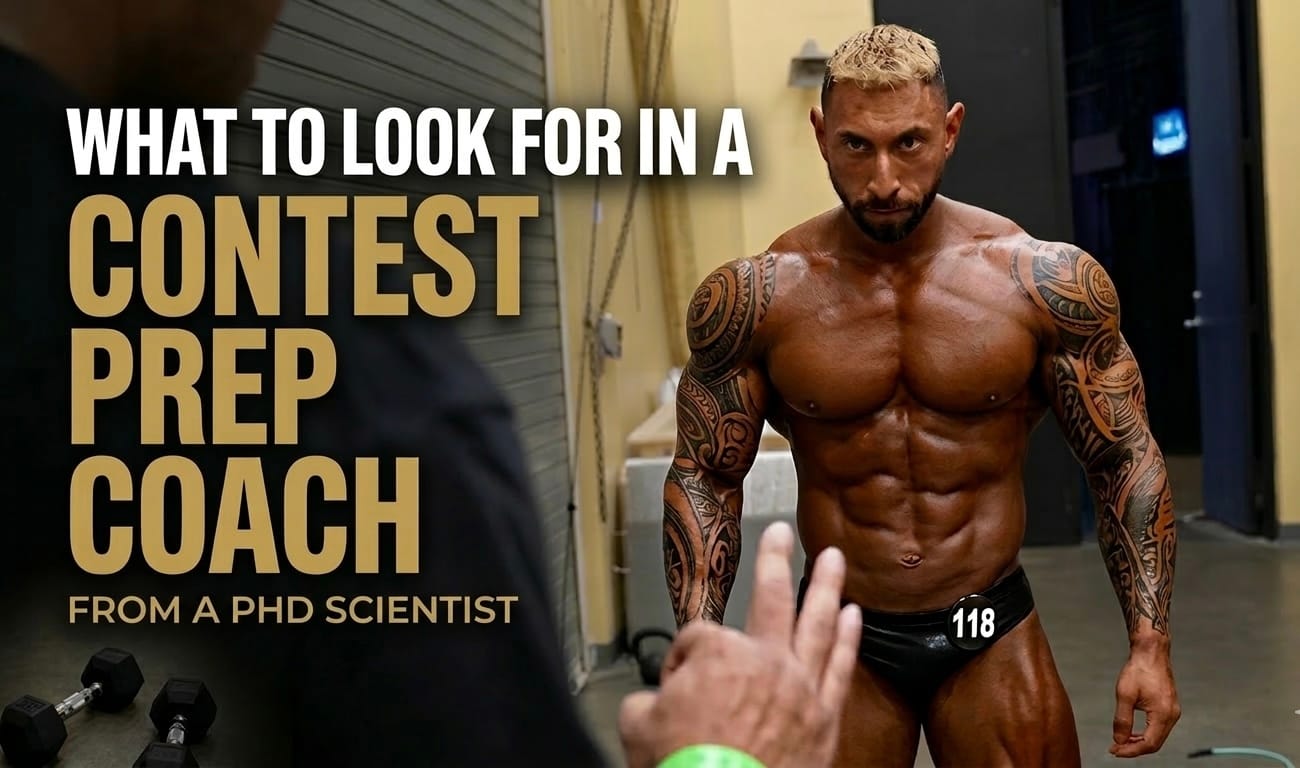
Hiring a contest prep coach is one of the most important decisions you'll make in your competitive career. The right coach can be the difference between stepping on stage in the best shape of your life and spending 16 weeks spinning your wheels, or worse, damaging your health in the process.
I've been on both sides of this. As a competitive athlete, engineer by training, and coach to 60+ athletes across Men's Physique, Classic Physique, Bikini, Wellness, and Figure, I've seen what separates elite coaching from the noise. Here's what you should actually be looking for.
1. They Build Your Program From a Needs Analysis, Not a Template Library
This is the single biggest red flag in the coaching industry. If your coach hands you a training program without first analyzing your physique relative to your division's judging criteria, you're getting a cookie-cutter plan with your name on it.
Here's what a real program design process looks like:
Step 1: Identify your division and what the judges are looking for. A Men's Physique athlete needs a completely different training emphasis than a Classic Physique competitor. Bikini and Wellness have overlapping aesthetics but dramatically different lower body priorities.
Step 2: Complete a full physique needs analysis. Every body part gets ranked as priority, middle, or strong based on how you currently stack up against the division standard. This isn't guesswork. It's a systematic evaluation done from your onboarding photos.
Step 3: Select a training split that matches YOUR weak points. The split drives volume distribution. A Men's Physique athlete who needs chest development gets a Chest Focused split with additional chest frequency built into the rotation. A Wellness athlete with lagging quads gets a Quad Specific template. The split is the strategy. It's not random.
Step 4: Plug in session templates that match each training day, with exercises selected for your body, your gym, and your experience level.
I had a Classic Physique competitor come to me from a well-known coach in the industry, someone with a big following and impressive clients on paper. But when I looked at the programming, the problem was obvious. This coach used the same peaking method and the same macro numbers for every athlete's final days leading into a show. Male or female, 180 lbs or 220 lbs, everyone got the same peak week template. It doesn't work because the plan isn't tailored to the individual athlete, and it tells you immediately that the coach doesn't have the micro-level knowledge of what's actually happening physiologically during peak week. Peak week is where precision matters most, and a one-size-fits-all approach is a recipe for coming in flat or spilled on stage day.
If you ask a potential coach "how do you decide my training split?" and they can't walk you through a process like this, keep looking.
2. They Understand Nutrition as Science, Not Just "Macros"
Every prep coach can hand you macros. But understanding WHY those macros are set where they are, and more importantly, when and how to adjust them, requires real knowledge.
A strong nutrition approach follows a clear hierarchy. Protein gets set first based on lean body mass, because that's what the research supports for muscle retention in a deficit. Fat has a floor. You don't drop it below a certain threshold because hormonal health depends on it, especially for female athletes. Carbohydrates fill the remainder and become your primary lever for adjustments throughout prep.
Your coach should be able to explain the reasoning behind every number in your plan. "Because that's what I give all my clients" is not an answer.
Beyond macros, ask about:
- Meal timing relative to YOUR schedule. Your plan should be built around when you wake up, work, train, and sleep, not the other way around. A good coach walks through your entire daily schedule before writing a single meal.
- Hydration protocols based on YOUR body. Most coaches either ignore hydration or throw out a generic "drink a gallon a day." A science-based approach calculates daily water intake from lean body mass, roughly 1 oz per pound of LBM, and distributes it across your between-meal windows so you're hydrated consistently, not chugging water at random.
- Sodium, the most misunderstood variable in prep. This is where bad coaching does real damage. Most coaches restrict sodium during prep, which is the opposite of what the research supports. Meta-analyses show the optimal sodium range for health outcomes is 2.6-5g per day, a U-shaped curve where both too little and too much create problems. Athletes training hard need even more: baseline intake of 3.5-5g daily, maintained at a 1:1 sodium-to-potassium ratio, plus an additional 500mg per hour of training. Sodium restriction during prep doesn't make you leaner. It tanks your performance, increases cortisol, and can cause dangerous fluid imbalances. Consistency matters more than restriction.
- Supplement rationale. Every supplement in your stack should have a reason. If your coach can't explain why something is there, it probably shouldn't be.
The most common mistake I see? Athletes cutting calories way too aggressively, way too early. They come to me with a destroyed metabolism. They've been in a steep deficit for weeks, their hormones are tanked, and they've hit a wall. They're burnt out and discouraged by week 8 or 10 of prep, and their progress has completely flatlined. Worse, their diet adherence starts slipping because the plan is unsustainable. When I inherit a client in this situation, the first thing I do is bring them back up to maintenance calories and give their body time to recover with a proper diet break. Let the hormones stabilize, let adherence improve, let the athlete feel human again. From there, we can either continue cleaning up the physique with a more measured approach or hold at maintenance until they're genuinely ready to push again. You can't out-diet a broken metabolism, and a good coach knows that sometimes the fastest path forward is a strategic step back.
3. They Use Photo Analysis, Not Just the Scale
If your coach's weekly check-in process is "send me your weight and we'll adjust," run.
The scale is one data point. A good check-in process collects weight trends, progress photos from consistent angles, compliance data (did you actually follow the plan?), wellness markers (sleep, energy, digestion, mood), and your own subjective notes about how you're feeling.
Photos are arguably the most important piece. A skilled coach can read subtle changes in muscle fullness, definition, and body fat distribution that the scale will never show. Week-over-week photo comparisons reveal whether you're actually progressing toward stage conditioning or just losing weight.
A lot of my new clients freak out about this at first, until I pull up a side-by-side comparison and walk them through what's actually happening. The scale doesn't tell the entire story. This is especially common with my female athletes who happen to get their period during check-in week. They've clearly lost body fat. You can see it plain as day in the photos: tighter midsection, more separation in the legs. But the scale jumps up about 2 lbs from water retention. If you're only looking at the number on the scale, that looks like a bad week. If you're looking at the photos, it's obvious the plan is working exactly as it should. A coach who panics and cuts your food based on a scale spike during your cycle is going to run your prep into the ground. A coach who reads the full picture (photos, weight trends over time, compliance, wellness) will keep you on track and save those dietary adjustments for when you actually need them.
4. They Know Your Division's Judging Criteria Inside and Out
This sounds obvious, but you'd be surprised how many "prep coaches" don't actually understand what judges are looking for in each class.
Men's Physique judges want back thickness and width as the primary differentiator, with delts that overpower the arms, developed triceps, and an upper chest shelf. Classic Physique is about the X-frame, and most athletes forget that glutes, adductors, and hip flexors are on display in the mandatory poses.
On the women's side, the differences are even more nuanced. Bikini emphasizes glutes and hamstrings with balanced shoulders and lats. Wellness shares that lower body focus but demands more overall leg development. Figure requires an X-frame with quad, hamstring, glute, delt, and tricep development that would be penalized in Bikini.
Your coach should be able to explain exactly how your training split maps to your division's priorities. If they're giving a Bikini athlete the same programming as a Figure athlete, they don't understand the divisions.
5. They Have a System for Adjustments, Not Just Intuition
Week 1 of prep is the easy part. Anyone can write a starting plan. The real coaching happens in weeks 8, 12, and 16 when progress stalls, motivation drops, and the body starts fighting back.
Ask a potential coach: "When do you make changes, and how do you decide what to change?"
A good answer involves specific triggers: rate of loss targets, weekly photo comparisons, compliance patterns, and recovery indicators. Changes should be reactive, made in response to what's actually happening, not preemptive. Dropping calories or adding cardio "just in case" is not a strategy.
The adjustment hierarchy matters too. A strong system follows two principles most coaches ignore:
The 70/30 Rule: When calories need to come down, 70% of the adjustment should come from nutrition and 30% from output (steps and cardio). This applies in both directions, cutting and adding. A coach who responds to a plateau by doubling your cardio while leaving your diet untouched is doing it backwards.
One Variable at a Time: Make one change, then evaluate for 7-14 days before reassessing. If your coach is simultaneously cutting carbs, adding HIIT, and changing your training split in the same week, they're panicking, not coaching. You'll never know what actually worked, and you'll run out of tools to pull when prep gets hard later.
A coach who jumps straight to cutting carbs when a simple step count increase would've solved the problem is leaving tools on the table that you'll need in weeks 12-16.
Bonus: Ask about Pre-Prep. An elite coach doesn't just have a prep plan. They have a pre-prep phase, a 2-8 week block before prep officially starts to lock in habits, standardize tracking, establish baseline cardio, draw labs, and assess global readiness. If your coach's "prep" starts with a drastic calorie cut on day one, they skipped the most important phase.
My philosophy is simple: be reactive, not preemptive. I don't cut food or add cardio because it's "week 8 and that's what the plan says." I make a single change when the data tells me to, then I wait 7-14 days to evaluate before touching anything else. Most coaches make too many changes at once because they're anxious, and then they have no idea what actually moved the needle. Patience and precision always beat panic.
6. They Communicate Consistently and Care About Your Health
Contest prep is physically and mentally demanding. Your coach should be someone you can reach when you need guidance, not someone who disappears for days and then sends you a generic response.
Look for structured communication: regular check-in days, clear turnaround times, and a system that makes you feel managed rather than forgotten.
And perhaps most importantly, your coach should care about your health beyond the stage. That means monitoring wellness markers throughout prep, having a clear plan for your reverse diet after the show, and being honest with you if your timeline isn't realistic.
A coach who pushes you to compete when you're not ready, or who has no plan for what happens after the show, doesn't have your best interests at heart.
At Team Bojacked, every athlete gets a structured post-show roadmap, not just a "good luck, eat what you want" text after the show. The progression looks like this: Reverse Diet to systematically bring calories back up without rapid fat gain, because jumping straight back to pre-prep intake is how you wreck your metabolism and your physique. Then a Health Phasefocused on restoring hormonal balance, digestion, sleep quality, and bloodwork markers, the things that take a real hit during prep. From there, a Clean-Up Phase to restore insulin sensitivity and tighten things up before we push into growth. And finally, Mass Building in a controlled surplus to add quality tissue for next season. Every phase has a purpose, and every transition is based on data, not a calendar. If your coach doesn't have a plan for what happens after the trophy, they're only coaching half the journey.
The Bottom Line
Finding the right prep coach isn't about who has the most followers or the flashiest transformations on Instagram. It's about finding someone who has a real system, understands the science, knows your division, and will be in your corner for the long haul.
If you're looking for coaching built on science, systematic programming, and genuine investment in your development, that's exactly what we do at Team Bojacked.